
Modern elite chess tournaments bring the world’s best players together under a fixed format, most often a round-robin where everyone plays everyone, with prize money and rating points on the line. The results feed the world rankings and help decide who reaches the Candidates and, ultimately, the World Championship.
These events are the day-to-day battleground of professional chess between title matches. A top player’s reputation is built far more on years of tournament results than on a single championship, since the elite calendar runs continuously. Consistency across many events matters as much as any one win.
Round-Robin vs Swiss Formats
The two dominant formats serve different needs. A round-robin suits a small, hand-picked elite field, while a Swiss system handles large open fields efficiently.
In a round-robin, every player faces every other player once, or twice in a double round-robin. This is the fairest format because everyone plays the same opposition, but it only works with a limited number of participants, usually eight to fourteen.
A Swiss system pairs players with similar scores each round without everyone meeting. It can accommodate hundreds of players over a fixed number of rounds, which is why big open events and qualifiers like the FIDE Grand Swiss use it.
| Format | Best for | Field size | Fairness |
|---|---|---|---|
| Round-robin | Elite invitationals | 8–14 players | Highest, equal opposition |
| Double round-robin | Small super-events | 6–10 players | Very high, both colors |
| Swiss | Open and qualifier events | Dozens to hundreds | Good, but uneven opposition |
| Knockout | World Cup, fast events | 128+ players | Exciting but variance-heavy |
Time Controls
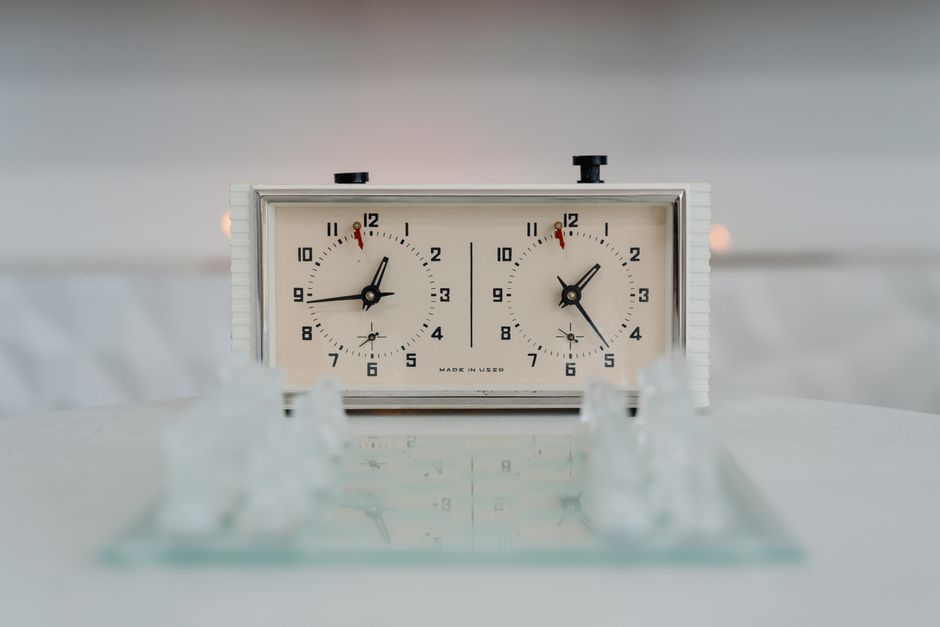
How much time players get shapes the entire character of a tournament. Classical chess, with long thinking time, rewards deep calculation and preparation. Faster controls reward intuition and nerve.
The main time controls used at the elite level are:
- Classical: Often around 90 to 120 minutes per player for the game, plus added time per move. Games can last five hours or more.
- Rapid: Roughly 15 to 25 minutes per player, producing quicker, sharper play.
- Blitz: About 3 to 5 minutes per player, where instinct dominates.
- Increment: Extra seconds added per move to prevent games being lost purely on the clock.
Most classical events now use an increment so that games are decided by chess rather than by a player running out of time in a winning position. This reflects a broad shift toward valuing quality of play over pure time pressure.
Tie-Breaks
When players finish level on points, tie-break rules decide the final placings, and these can be decisive for prize money and qualification. Different events use different systems.
Common tie-break methods include the number of wins, the results of direct encounters between the tied players, and performance-based scores that weigh the strength of opposition faced. Many elite events now settle first place with a playoff of rapid or blitz games rather than a mathematical formula, since a decisive over-the-board result feels fairer to fans.
A tie-break method should be announced before the tournament begins, because players adjust their risk-taking in the final rounds based on how ties will be resolved.
The Major Events
A handful of tournaments anchor the elite calendar each year, and winning them carries real prestige. They vary in tradition, location, and character.
- Tata Steel Chess in Wijk aan Zee, Netherlands, held every January, is one of the oldest and most prestigious annual events, running since 1938.
- Norway Chess, held in Stavanger, gathers a small super-elite field and has experimented with formats that reduce draws.
- The Sinquefield Cup in Saint Louis is part of the Grand Chess Tour and a fixture of the American chess scene.
- The FIDE World Cup is a massive knockout that also serves as a Candidates qualifier.
Tata Steel is often called the "Wimbledon of chess" because of its long history, tough field, and the way a strong result there defines a player’s season. Its multiple sections also let rising talents earn their way toward the top group.
The Fight Against Draws
A persistent challenge at the elite level is the high draw rate. When the best players are so well prepared, many classical games end without a winner, which can frustrate spectators. Organizers have tried several responses.
Some events forbid players from agreeing to a draw before a set number of moves. Others award more points for a win than the traditional system, or use faster tie-break games to guarantee a decisive result. Norway Chess, for example, has used an "Armageddon" game after drawn classical games, where black wins the mini-match with a draw but gets less time.
These experiments reflect a real tension. Classical chess at the top is extraordinarily deep, but that same depth makes decisive results harder to force. Organizers must balance competitive integrity against the need to keep events watchable for a growing online audience.
Why Tournaments Matter
For professional players, the tournament circuit is both livelihood and proving ground. Prize money, appearance fees, and rating points all flow from these events, and strong results earn invitations to the most exclusive fields.
For fans, tournaments provide the continuous drama that title matches, held only every year or two, cannot. Streaming and online commentary have made elite events more accessible than ever, with millions following the moves in real time.
Prize funds and appearance fees vary widely between events, and the strongest players can earn a substantial share of their income from a handful of top invitationals. This financial reality shapes the calendar, since players must balance ambition, rating protection, and rest across a demanding year.
The formats will keep evolving as organizers chase both fairness and excitement, but the core purpose stays the same. Elite tournaments are where the world’s best test themselves against one another, week after week, in the long contest that decides who truly stands at the top of the game.